
Hospital length of stay is often discussed as a discharge problem.
But many avoidable hospital days are created earlier—when the information needed to move care forward is already available, yet the next decision or action does not happen promptly.
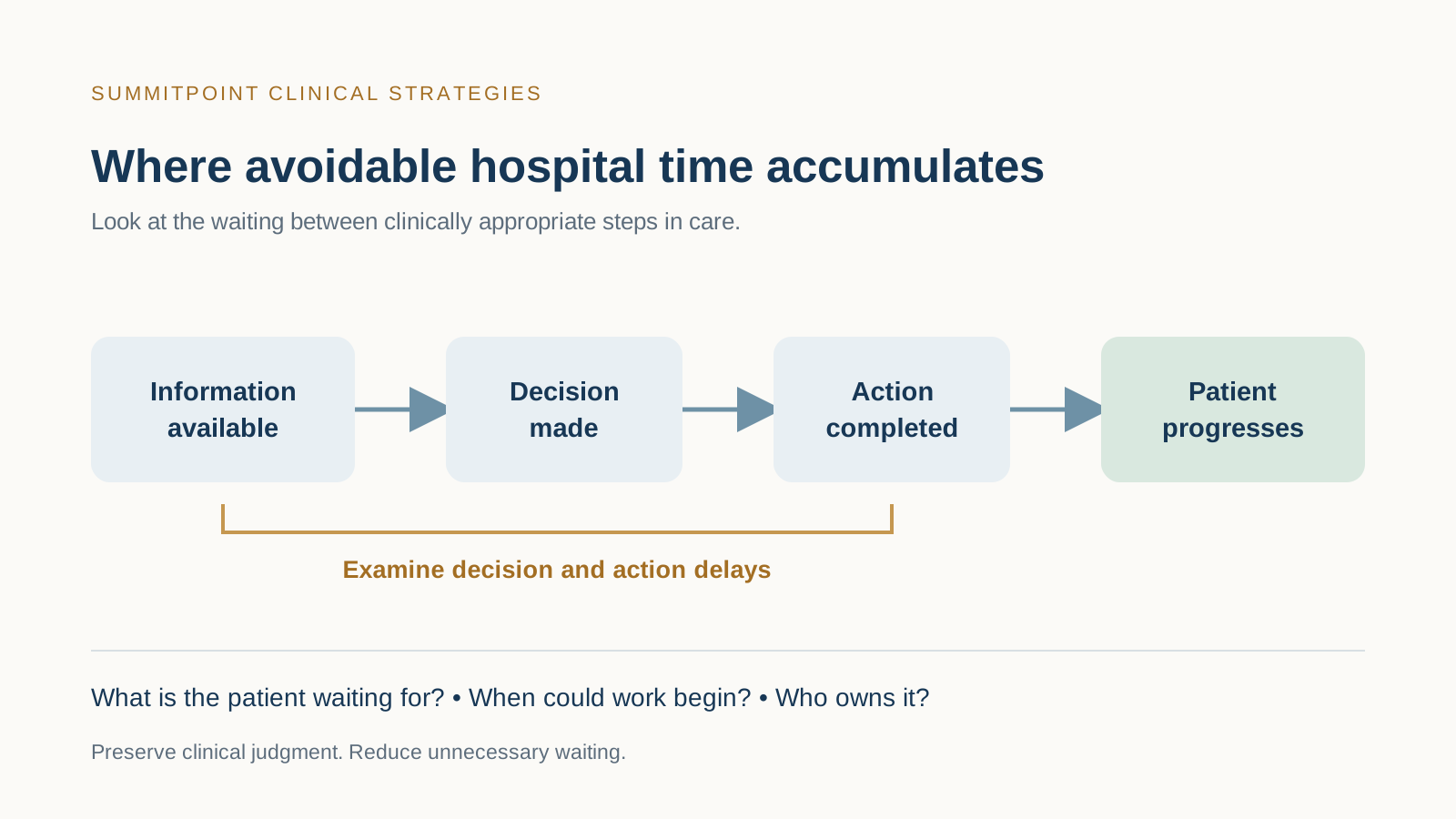
That gap is decision latency: the time between having enough information to act, making the decision, and completing the next step.
Information available → decision made → action completed → patient progresses
Some decision latency is clinically appropriate. Patients evolve, diagnoses remain uncertain, and good clinical judgment sometimes requires more time.
The operational problem appears when the same types of decisions are repeatedly delayed because ownership is unclear, work is sequenced poorly, or communication depends on someone remembering to follow up.
The goal is not faster discharge.
It is less unnecessary waiting between clinically appropriate steps in care.
The Delay Often Starts Before Discharge Day
Consider a patient who remains hospitalized because skilled nursing placement is not ready.
The visible delay occurs when the patient is medically ready to leave. But the actual delay may have started two days earlier, when therapy first suggested that discharge home was unlikely.
The same pattern occurs throughout inpatient care.
A consultant recommendation needed for disposition may be requested late in the stay. A diagnostic result may be available in the morning but not incorporated into the plan until the next day. A medication-access problem may not be discovered until prescriptions are prepared. Transportation or family barriers may surface only after the discharge order is written.
The final delay is real.
But the opportunity often exists earlier.
A more useful question than “Why wasn’t this patient discharged?” is:
When did we first have enough information to know what needed to happen next?
That question shifts the review upstream.
Decision Latency Is Not the Same as Clinical Complexity
Not every long hospitalization reflects poor operations.
A patient who needs another 24 hours to assess response to therapy is using clinically necessary time.
A patient who remains because the diagnostic study needed for disposition cannot be performed until tomorrow may be experiencing a capacity constraint.
A patient whose study was completed at 9 a.m., resulted at 10 a.m., but whose plan was not revisited until the following morning may be experiencing decision latency.
All three patients may cross another midnight.
Operationally, they are very different problems.
That distinction matters because the interventions are different. Clinical uncertainty may require time. Capacity constraints may require resources or scheduling changes. Decision latency usually points toward workflow, ownership, or escalation.
Sequential Work Creates Delay
Hospital care often progresses sequentially.
The primary team evaluates the patient. Then a consultation is requested. The consultant evaluates the patient. Then testing occurs. Then disposition planning begins.
Each step may be appropriate. The problem is that the next step often waits until the prior step is completely finished.
Some work can safely occur in parallel.
If post-acute placement is likely, planning can begin while treatment continues. If therapy will influence disposition, the evaluation does not always need to wait until every medical issue is resolved. If medication affordability may change the plan, that risk can be identified before the final prescription is written.
Parallel planning does not mean making premature clinical decisions.
It means recognizing predictable dependencies early enough that they do not become last-minute barriers.
Three Questions for the Additional Hospital Day
For leaders reviewing an avoidable day, the analysis can start with three questions:
- What was the patient waiting for?
- When was enough information available to act?
- Who owned the next decision or action?
Those questions often reveal more than the length-of-stay number itself.
If consultant-dependent discharges repeatedly slip even after recommendations are available, the issue may be response time.
If post-acute needs are consistently identified late, the opportunity may be earlier planning.
If medication barriers routinely emerge at discharge, the workflow may be sequencing the work too late.
If everyone recognizes the barrier but no one clearly owns the next step, the problem is accountability.
The objective is not to assign blame. It is to understand why patient progression stopped.
Repeated Delays Are Operational Signals
One delayed decision may be unavoidable.
Repeated delays of the same type are different.
Patterns tell leaders where the operating model is weak.
The solution may be an earlier trigger, clearer ownership, a more reliable escalation pathway, different service expectations, or a change in how work is sequenced.
That is why average length of stay alone cannot diagnose the problem. It tells leaders that time accumulated, but not where the time was lost.
The more useful operational insight is identifying the moments when the organization already knew enough to move forward—but did not.
Reliability, Not Speed
Reducing avoidable hospital days should never become pressure to discharge patients before they are ready.
Some patients need more time. Some decisions appropriately take time. Some barriers remain outside the hospital’s direct control.
But patients should not remain hospitalized simply because the next decision lacked an owner, the next action began too late, or a predictable dependency was recognized only at the end of the stay.
For hospital leaders, the better question is:
What decision or action most often keeps our patients in the hospital after the next step in care is already reasonably clear?