

When a primary care team is overwhelmed, the first response is often to add another nurse, advanced practice provider, physician, or medical assistant.
Sometimes additional staff are necessary. But staffing alone cannot correct unclear responsibilities, unnecessary handoffs, or work consistently reaching the wrong person. As healthcare organizations continue to navigate staffing shortages, leaders also need to distinguish between a true staffing gap and a workflow bottleneck that makes existing capacity harder to use effectively. Without redesigning the underlying workflow, a new team member may simply become another stop in an already fragmented process.
Before leaders determine how many people a clinic needs, they should first understand the work the team is being asked to perform.
Begin With the Work, Not the Organizational Chart
Primary care includes far more than scheduled visits.
Teams manage prescription refills, test results, portal messages, prior authorizations, preventive care gaps, hospital follow-up, chronic disease monitoring, forms, referrals, and requests for clinical advice. Much of this work occurs between appointments, yet it can consume substantial clinical capacity.
In many clinics, these responsibilities have accumulated without intentional redesign. Tasks are routed according to habit, convenience, or historical practice rather than according to the skills required to resolve them.
Nursing can become the default destination for unresolved work. Physicians may spend time responding to requests that could safely be resolved by another team member. Medical assistants may have the capability to perform additional work but lack the protocols, training, information, or authority to act.
The result is more than inefficiency.
It can create slower response times, duplicated work, inconsistent processes, staff frustration, reduced appointment capacity, and unnecessary escalation to higher-cost resources.
The underlying issue may not be that the team lacks people.
It may be that the team has not clearly designed who does what, when, and with what authority.
Make Four Decisions About the Work
A practical review of primary care team design should answer four questions:
1. What work must be done?
Start by identifying the full range of work required to support patients before, during, and between visits.
Look beyond the appointment schedule. Include inbox management, refills, results, referrals, preventive care, forms, follow-up, care gaps, patient communication, and other recurring work.
If the work is not visible, it is difficult to determine whether the team is appropriately designed or staffed.
2. What level of judgment does it require?
Not every task requires the same level of clinical expertise.
Determine whether the work requires:
- Administrative processing
- Protocol-based action
- Clinical assessment
- Independent clinical judgment
- Provider-level decision-making
This distinction creates the foundation for appropriate delegation.
3. Who can resolve it without another handoff?
The goal should be to route work to the team member most likely to resolve it safely and efficiently the first time.
If a task routinely moves from medical assistant to nurse to provider and back again, the problem may not be workload alone. The workflow may be poorly designed.
4. Who owns the final outcome?
Someone should be accountable for ensuring the work is completed.
Ownership is different from simply receiving a task.
A team member who receives a message but must forward it to someone else does not necessarily own the outcome. Effective workflows define where responsibility ultimately resides and what happens when the work cannot be resolved at that level.
Delegation Must Include the Ability to Act
Effective team design does not mean moving every possible responsibility away from physicians or nurses.
It means matching work with the appropriate level of expertise and giving that team member what is needed to resolve it.
Delegating responsibility without appropriate training, protocols, authority, information, or dedicated time does not solve the problem. It simply relocates the burden.
Consider a few common examples.
A medical assistant supporting preventive care may be able to close defined care gaps when standing orders and escalation criteria are in place.
A nurse managing portal messages needs routing rules that distinguish clinical assessment from scheduling, forms, medication questions, and other administrative requests.
An advanced practice provider managing chronic disease follow-up needs clarity around the patients, decisions, and outcomes they own.
When those supports are absent, work is more likely to be forwarded, repeated, delayed, or returned to the physician.
Delegation creates capacity only when responsibility is paired with the authority and resources to act.
Reduce Handoffs That Do Not Add Value
Every handoff introduces another opportunity for delay, misunderstanding, duplication, or lost information.
That does not mean collaboration is the problem.
The problem is unnecessary movement of work.
Primary care teams should be designed so work reaches the person able to resolve it as early as possible. That requires clear routing rules, standardized protocols, defined escalation pathways, and access to the information necessary to make a decision.
A useful workflow question is:
How many people need to touch this work before the patient receives an answer or the task is complete?
The answer can reveal opportunities that a staffing ratio alone cannot.
The objective is not to eliminate collaboration.
It is to eliminate handoffs that do not add clinical or operational value.
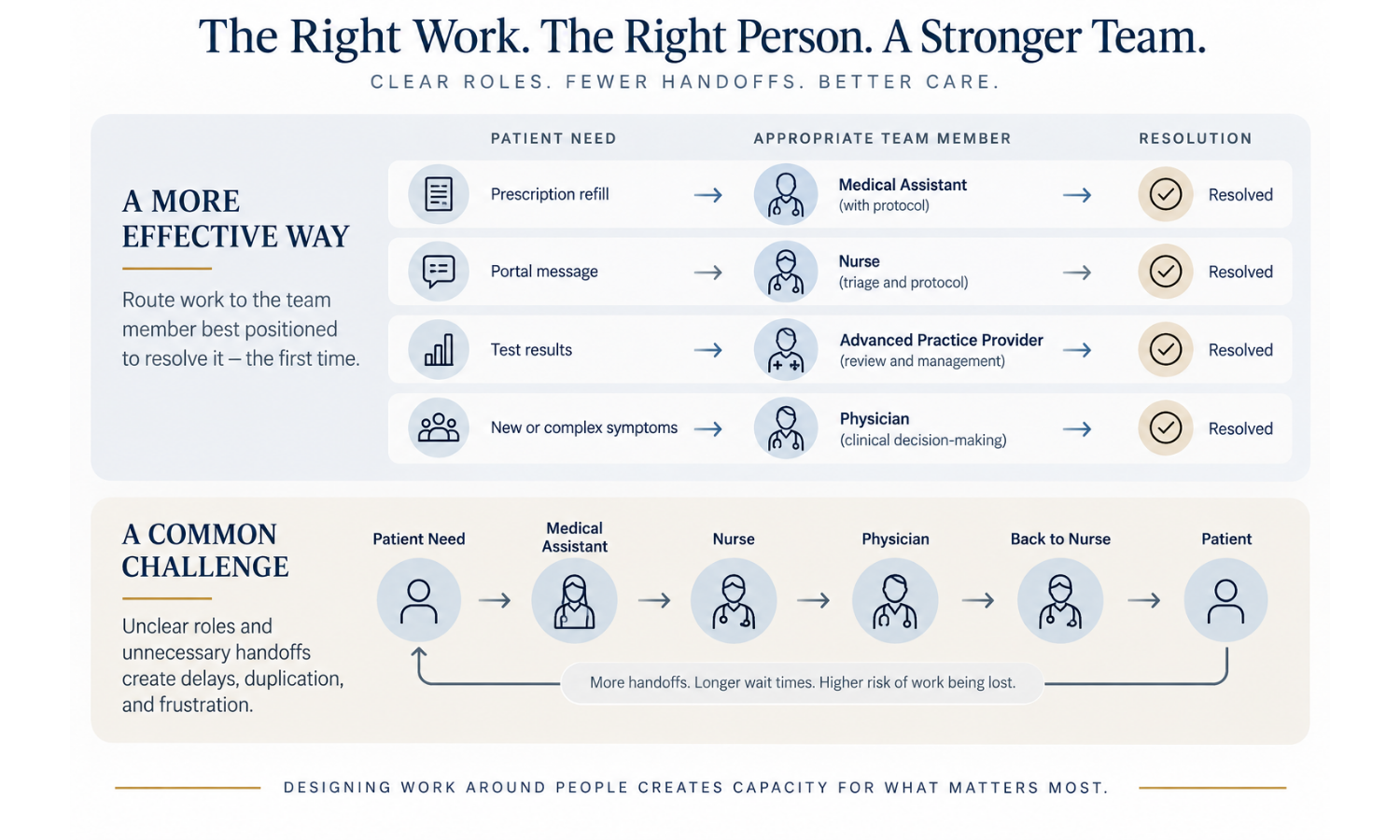
For example, if routine refill requests are consistently routed to a nurse, reviewed by a physician, returned for additional information, and then sent back to the nurse, adding another nurse may increase the number of people available to process the workflow without addressing the underlying problem.
A better approach may be to redesign the refill process so appropriate requests are resolved through a defined protocol and only exceptions escalate for clinical review.
The same principle applies when work moves beyond the primary care team. Referrals, specialty consultations, hospital follow-up, and other transitions require clear ownership through completion. Closed-loop care coordination helps ensure that responsibility does not end when a referral or request is sent—it continues until the necessary action, response, or follow-up is completed.
Design Roles Around Outcomes
Traditional job descriptions often describe activities without establishing ownership.
A stronger team model defines what each role is expected to accomplish and how responsibility extends through completion.
Consider previsit planning.
Instead of simply assigning someone to “prepare charts,” the workflow can define who reviews the record, identifies care gaps, prepares allowable orders, addresses missing information, and escalates unresolved clinical questions before the patient arrives.
Chronic disease management requires similar clarity.
Who monitors results? Who provides education? Who initiates follow-up? Who identifies patients who need earlier clinical review? Who is responsible for ensuring the next step occurs?
When ownership extends through completion, teams recognize incomplete work sooner and patients are less likely to fall between steps.
Standardization Should Support the Team
Primary care will always require clinical judgment. Standardization should create clarity around common situations while preserving appropriate escalation for exceptions.
Standing orders, refill protocols, message-routing guidelines, previsit planning processes, and defined follow-up workflows can reduce unnecessary variation and make delegation safer.
But standardization is only effective when it reflects the clinic’s actual operating environment.
A protocol that exists only on paper does not redesign the work.
Teams need practical tools, training, leadership support, appropriate technology, and a reliable mechanism for identifying when the process is not working as intended.
Leaders should also regularly review whether a protocol is creating the intended result. A workflow that was appropriate two years ago may no longer fit the team’s staffing model, patient population, technology, or volume.
Operational design is not a one-time exercise.
Better Team Design Creates Capacity
When work is matched appropriately, providers regain time for decisions that require their expertise.
Nurses spend less time serving as intermediaries for administrative or routine requests. Medical assistants and other team members contribute more fully within clearly defined roles. Patients receive more consistent and timely responses.
Most importantly, the team can create capacity without assuming that every capacity problem requires another position.
Primary care capacity is not determined only by the number of available appointments.
It is also shaped by how effectively the team manages the work surrounding those appointments.
That distinction matters when leaders are evaluating staffing requests.
A clinic may genuinely need another position. But leaders should understand whether the additional person will solve a capacity constraint—or simply absorb work created by an inefficient process.
Start With One Workflow
Before approving another position, expanding visit templates, or introducing new technology, leaders can begin with one high-volume workflow.
Choose something such as:
- Prescription refills
- Test results
- Portal messages
- Referral management
- Previsit planning
- Hospital follow-up
- Preventive care gaps
Then map the work from beginning to end.
Identify:
- Every person who touches the work
- Every handoff
- Every point where the work waits
- Every duplicate step
- Every escalation
- Every decision that could be made earlier
- Every point where staff lack the information or authority to act
The objective is not simply to count touches.
It is to understand why the work moves.
If a task requires multiple handoffs because each role lacks the authority, information, protocol, or training to complete it, the solution may be workflow redesign rather than additional staffing.
The Question Leaders Should Ask
Staffing is an important component of primary care operations. But it should not be the first or only lever leaders consider when teams are overwhelmed.
Before adding people, understand the work.
Before expanding capacity, understand where capacity is being consumed.
Before assigning responsibility, ensure the person has the authority and resources to act.
And before measuring productivity, determine whether the workflow itself is creating unnecessary work.
The question is not simply:
“Who can receive this work?”
The better question is:
“Who can safely resolve it—and what information, authority, protocols, and accountability do they need to do so?”
That shift—from staffing first to work design first—can reveal opportunities to reduce handoffs, improve role clarity, increase team capacity, and create a more reliable experience for both patients and clinicians.
At SummitPoint Clinical Strategies, we help healthcare leaders examine the work behind operational challenges—not just the symptoms they create. Understanding how work moves through a team is often the first step toward building a more efficient, sustainable operating model. Take our operational assessment to identify workflow and operational challenges that may be limiting your team’s capacity.