
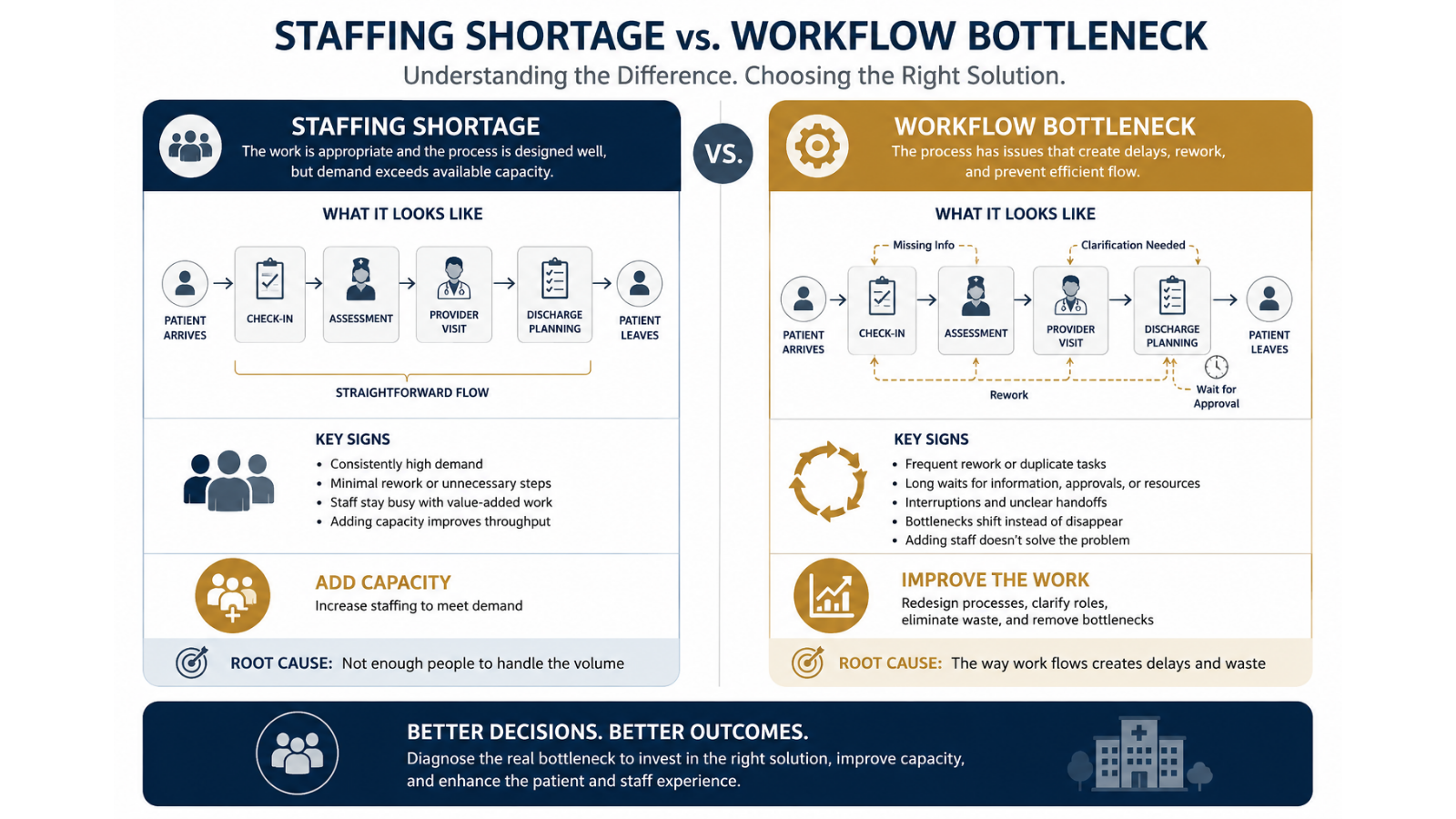
Staffing shortages are one of healthcare’s biggest challenges. Yet many organizations unintentionally make them worse by assuming every operational bottleneck requires another hire. Before adding FTEs, leaders should first determine whether the constraint is truly staffing—or whether the work itself is creating the problem.
The Operational Challenge
Healthcare leaders are under constant pressure to solve staffing shortages. Many of those shortages are real. But not every operational problem that feels like a staffing problem is actually caused by insufficient staff.
Sometimes the issue is fragmented workflow, unclear role design, poor handoffs, inefficient technology, unnecessary variation, or demand arriving at the wrong time in the wrong place.
In many organizations, small inefficiencies repeated hundreds of times each day consume the equivalent of multiple full-time positions. When leaders misdiagnose the problem, they may add staff without fixing the underlying work. The result is higher labor costs, frustrated teams, and the same operational bottlenecks that existed before.
What Leaders Usually See
Operational symptoms often appear long before the root cause is understood. Leaders may see:
- Rising overtime
- Long patient wait times
- Staff frustration and burnout
- Growing backlogs
- Increased call-outs
- Managers repeatedly requesting additional FTEs
- Declining patient access or appointment availability
These warning signs deserve attention. But they do not automatically prove that staffing is the primary issue.
Why the Usual Fix Falls Short
A true staffing problem exists when the workload is appropriate, the process is well designed, roles are clearly defined, and demand still exceeds available capacity.
A workflow problem exists when staff spend significant time on rework, unnecessary steps, avoidable interruptions, inefficient documentation, unclear escalation pathways, or tasks that could be completed more effectively by another role or process.
The distinction matters because the solutions are fundamentally different.
Adding employees to an inefficient process often increases cost without meaningfully improving throughput. By contrast, redesigning workflows can reduce delays, improve employee satisfaction, and increase capacity using existing resources.
This principle is especially important in ambulatory care, where organizations often respond to access challenges by recruiting additional providers before evaluating scheduling practices, referral management, care team design, or clinic operations. As discussed in our article, Specialty Access: Why Adding Providers Alone Doesn’t Fix the Problem, expanding capacity without improving operations rarely produces lasting results.
Adding staff to an inefficient process increases cost—but it rarely eliminates the bottleneck.
Signs You May Have a Workflow Problem Instead of a Staffing Problem
Consider whether any of these situations sound familiar:
- Productivity varies significantly between teams performing similar work.
- Staff spend large portions of their day waiting for approvals, information, or room availability.
- Overtime continues even after additional employees are hired.
- Newly hired staff become overwhelmed within weeks.
- Different departments perform the same work using different processes.
- Bottlenecks shift from one department to another instead of disappearing.
If several of these conditions exist, workflow redesign may deliver greater improvements than additional staffing alone.
Where to Start
Before approving additional positions, observe the work where it actually occurs. Follow the patient, the information, and the staff member through the process. The objective is to understand where time is spent, where work stops, and what prevents the next step from occurring.
Ask questions such as:
- How many steps are required?
- How often are staff interrupted?
- Where does rework occur?
- Which tasks require clinical judgment and which do not?
- What is waiting for approval, a signature, a room, a phone call, or a system response?
A structured workflow assessment often reveals whether the organization lacks people, lacks process, lacks role clarity—or some combination of all three.
If you’re unsure where to begin, our Operational Assessment provides a structured way to identify operational constraints before making major workforce investments.

Questions Every Healthcare Leader Should Ask
Before approving additional staffing, consider these questions:
- Is the work itself appropriate for the role performing it?
- Where does rework occur most frequently?
- What tasks could be removed, simplified, automated, or reassigned?
- Are clinical staff spending time on work that could be delegated?
- Is the primary bottleneck capacity, workflow, role design—or all three?
These questions often uncover opportunities that staffing models alone cannot solve.
A Practical Perspective
At SummitPoint Clinical Strategies, we believe workforce strategy and operational strategy must be developed together.
Staffing decisions should be grounded in the actual work being performed—not simply the pressure felt by a department. Effective operational leaders evaluate workflow, role design, technology, patient demand, and capacity before determining whether additional staffing is truly necessary.
Strong physician and clinical leadership also play an essential role in this process. Leaders who understand both clinical operations and organizational strategy are better positioned to identify the true source of operational constraints before investing additional resources.
The Leadership Question
Every staffing request deserves careful evaluation. Sometimes the right answer is additional capacity. Other times, the greatest opportunity lies in redesigning the work itself.
Organizations that distinguish between staffing shortages and workflow constraints make better investments, improve employee satisfaction, strengthen patient access, and deliver more consistent care.
Before approving the next staffing request, has your organization confirmed whether the bottleneck is capacity, workflow, role design—or all three?