

Community hospitals should transfer patients when higher-level care is necessary. Specialized procedures, advanced interventions, and complex clinical needs often require resources that only larger facilities can provide.
The opportunity is not to prevent appropriate transfers. The opportunity is to identify which patients can safely receive care closer to home and build the support systems that make local care possible.
For many rural and community hospitals, transfer patterns reveal opportunities to strengthen operations, improve patient access, and expand local capabilities.
Why Community Hospitals Transfer Patients
Healthcare organizations transfer patients for many legitimate reasons. Clinical complexity, specialty availability, advanced diagnostics, procedural requirements, and patient preference all influence transfer decisions.
However, not every transfer stems from a clinical necessity.
Some transfers occur because clinicians cannot access specialist support quickly. Others happen because teams lack clear protocols, available resources, or confidence that local services can manage the patient safely.
When leaders examine transfer data closely, they often discover opportunities to improve care delivery without compromising patient safety.
What Leaders Often See
Hospital leaders frequently notice several warning signs:
- Rising transfer volumes
- Patient frustration with traveling for care
- Loss of local care continuity
- Increased strain on referral centers
- Inconsistent transfer decisions among providers
In some organizations, one provider manages a condition locally while another transfers a similar patient. That variation often signals an operational issue rather than a clinical one.
Understanding why those differences exist creates the foundation for improvement.
Four Drivers of Avoidable Transfers
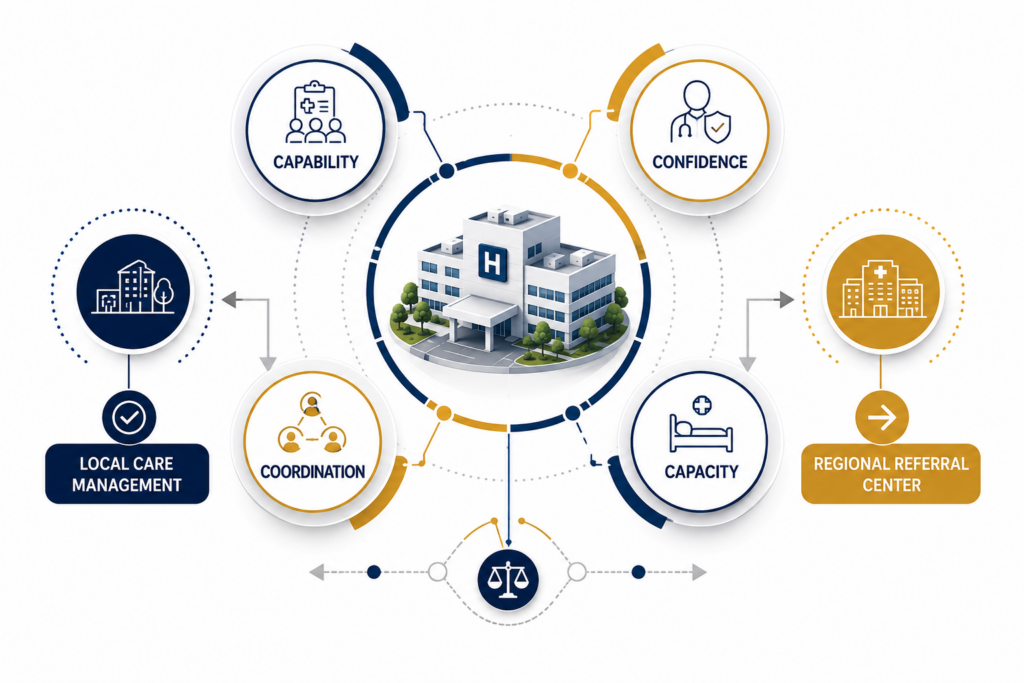
Most potentially avoidable transfers fall into four categories: capability, confidence, coordination, and capacity.
Capability
Capability refers to the services, technology, and clinical resources available within the organization.
A hospital may lack access to specific diagnostics, procedures, therapies, or specialty support that would allow local treatment.
Confidence
Confidence reflects how comfortable clinicians feel managing a patient locally.
Even when resources exist, providers may choose transfer if they lack specialist support, clear guidance, or experience with a particular condition.
Coordination
Coordination involves communication and escalation processes.
Hospitals need clear pathways for obtaining specialist consultation, escalating concerns, and determining when local management remains appropriate.
Strong coordination often prevents unnecessary transfers.
Capacity
Capacity includes beds, staffing, diagnostics, therapies, and ancillary services.
A hospital may possess the clinical capability to manage a patient, but lack the resources available at that moment to provide care safely.
Organizations that focus on only one of these areas rarely achieve meaningful improvement. Transfer decisions usually reflect multiple factors working together.
Where Leaders Should Start
Start with a structured review of transfer data.
Analyze transfers by:
- Diagnosis
- Reason for transfer
- Time of day
- Receiving facility
- Provider
- Required intervention after transfer
Next, separate clearly appropriate transfers from cases that warrant additional review.
Then identify the diagnoses that create the highest transfer volumes and assess whether local management could improve through:
- Standardized clinical protocols
- Tele-specialty partnerships
- Staffing enhancements
- Workflow redesign
- Service line development
- Expanded diagnostic capabilities
The goal is not to assign blame.
The goal is to identify practical opportunities that improve patient access and strengthen local care delivery.
Questions Every Leadership Team Should Ask
As organizations evaluate transfer patterns, several questions deserve attention:
- Which transfer types are consistently appropriate?
- Which diagnoses show significant variation among providers?
- What local capabilities would change transfer decisions?
- Where could specialist support improve confidence?
- Which operational barriers drive transfers most often?
The answers often reveal opportunities that leaders can address through targeted operational improvements.
A Practical Perspective
Reducing avoidable transfers requires more than a utilization initiative.
Successful organizations align physicians, nursing leaders, emergency departments, hospital medicine teams, specialty services, and regional partners around a shared strategy.
That strategy should support clinicians, protect patient safety, strengthen local access, and improve care continuity across the region.
Hospitals that approach transfer optimization as a clinical and operational strategy often identify opportunities to enhance services while maintaining strong relationships with referral partners.
The Leadership Question
Which patient transfers in your organization clearly require higher-level care, and which ones reveal opportunities to strengthen local capability, improve coordination, and keep patients closer to home?