
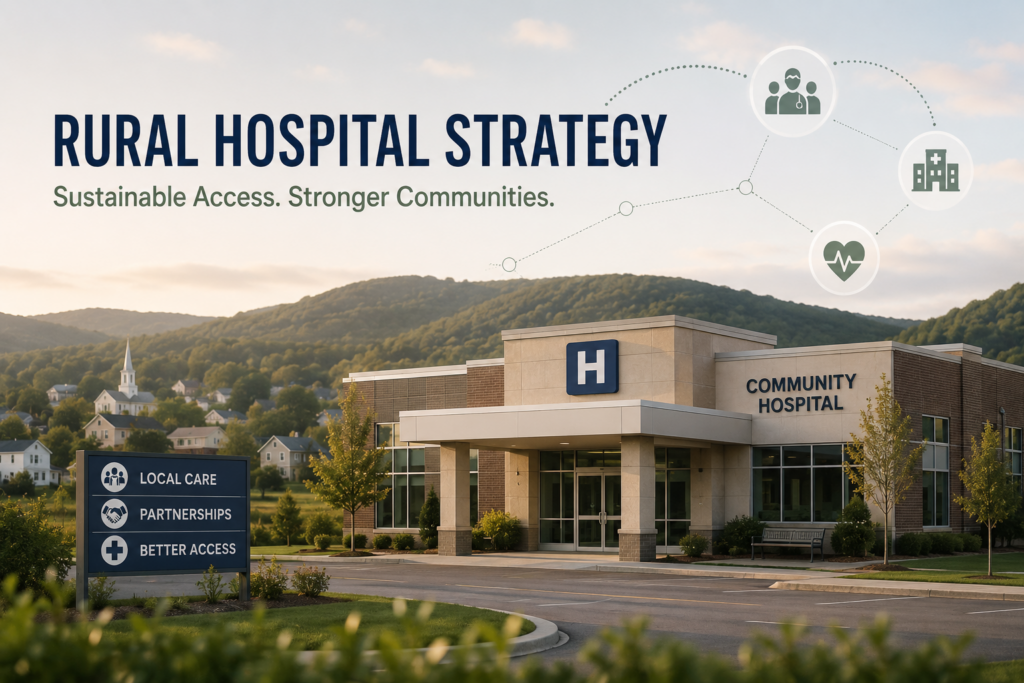
The future of a rural hospital should not be reduced to a simple question of independence versus affiliation. The more important question is whether the community can reliably access the services it needs.
The Strategic Challenge
Rural hospital strategy often centers on whether an organization should remain independent or affiliate with a larger system. That framing misses the larger challenge.
Leaders must determine how to sustain reliable access to essential services while maintaining workforce stability, clinical quality, and operational performance. Independence may support that goal. Affiliation may support it. Strategic partnerships may support it. None of those structures matter, however, if patients cannot access reliable care when they need it.
When essential services become unreliable, the consequences extend beyond the hospital itself. Patients experience delayed care, longer travel times, fragmented treatment, and increased dependence on already strained regional health systems. Communities ultimately judge healthcare access by whether care is available when needed—not by the organizational structure behind it.
What Leaders Usually See
Rural and community hospitals face a familiar set of pressures: thin specialist coverage, recruitment difficulty, transfer dependence, aging facilities, payer mix challenges, and rising expectations from patients who compare local access to larger regional centers.
These challenges cannot be solved by identity alone. A hospital can remain independent and still lose key services. It can be affiliated and still struggle operationally. It can partner and still fail to create a reliable care model.
The debate over structure often distracts leaders from the more important question: which services can realistically be sustained over the long term, and how should access be delivered when local resources are limited?
The Root Issue
The core issue is service sustainability.
Leaders need to understand which services are essential to local access, which are strategically differentiating, which are financially vulnerable, and which require regional partnership to remain safe and reliable.
This requires honest analysis of:
- Patient volume and utilization trends
- Workforce availability and recruitment risk
- Physician call burden
- Quality and safety performance
- Transfer and referral patterns
- Community health needs
- Capital and infrastructure requirements
Without this analysis, strategic decisions become reactive rather than intentional.
Where to Start
A practical starting point is a service line sustainability review.
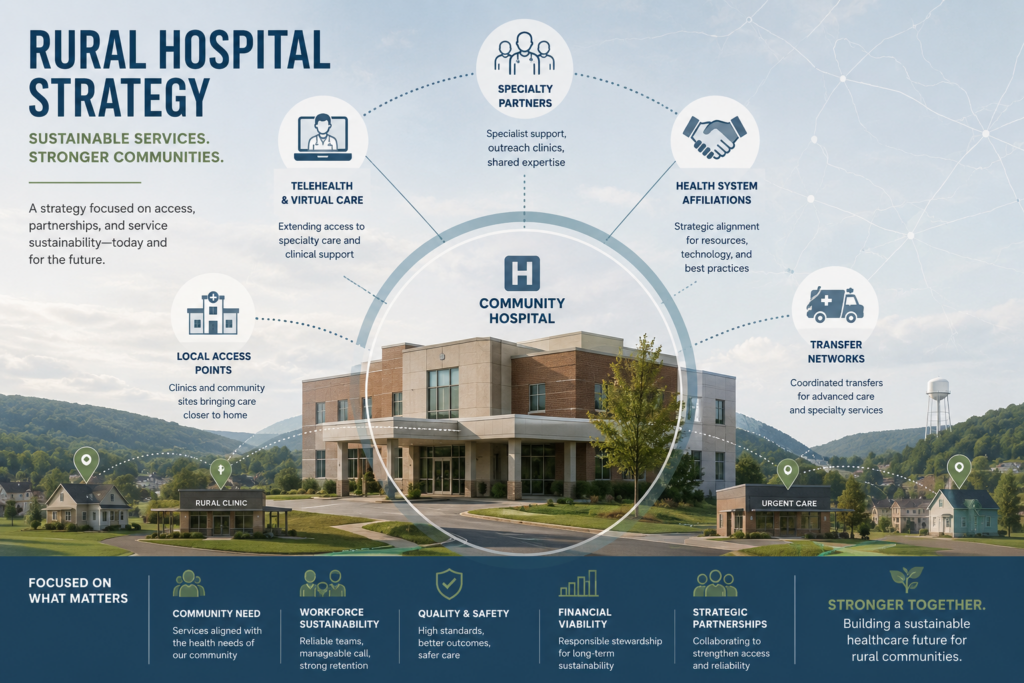
Leaders should evaluate each service through four lenses:
Community Need
Does the service address a critical healthcare need within the population served?
Workforce Sustainability
Can the organization maintain reliable physician, advanced practice provider, nursing, and support staff coverage?
Quality and Safety
Is the service consistently meeting clinical quality, patient safety, and regulatory expectations?
Financial Viability
Can the service remain operational with realistic reimbursement, volume, and investment assumptions?
The objective is not to preserve every service locally at all costs. The objective is to develop a rational access strategy that protects both the community and the organization.
Rethinking Partnerships
Partnerships should not be viewed as a loss of independence. In many cases, they are a practical mechanism for preserving access.
Not every service must be delivered through a hospital-employed model. Regional call-sharing agreements, specialty outreach programs, telehealth partnerships, co-management arrangements, and clinical affiliations can often strengthen service reliability while reducing workforce strain.
The most effective partnerships are designed around patient access and clinical sustainability rather than organizational identity.
Questions for Leaders
As healthcare continues to evolve, rural hospital leaders should regularly ask:
- Which services are essential to local access?
- Which services are clinically or operationally vulnerable?
- Which transfers could reasonably be avoided?
- Which services require a different delivery model?
- Which partnerships would strengthen reliability and sustainability?
- What does our community need most from us over the next five years?
A Practical Perspective
SummitPoint’s perspective is that rural strategy must be practical. It should respect local identity while confronting operational reality.
Strong rural strategy focuses on sustainable access rather than slogans about independence. It is about designing care models that are clinically sound, financially realistic, operationally reliable, and sustainable for the workforce.
Organizations that focus on service sustainability are often better positioned to preserve community access regardless of whether they remain independent, affiliate with a larger system, or pursue strategic partnerships.
The Leadership Question
Is your rural hospital strategy centered on organizational structure—or is it centered on ensuring that the services your community depends upon remain accessible, reliable, and sustainable for years to come?