
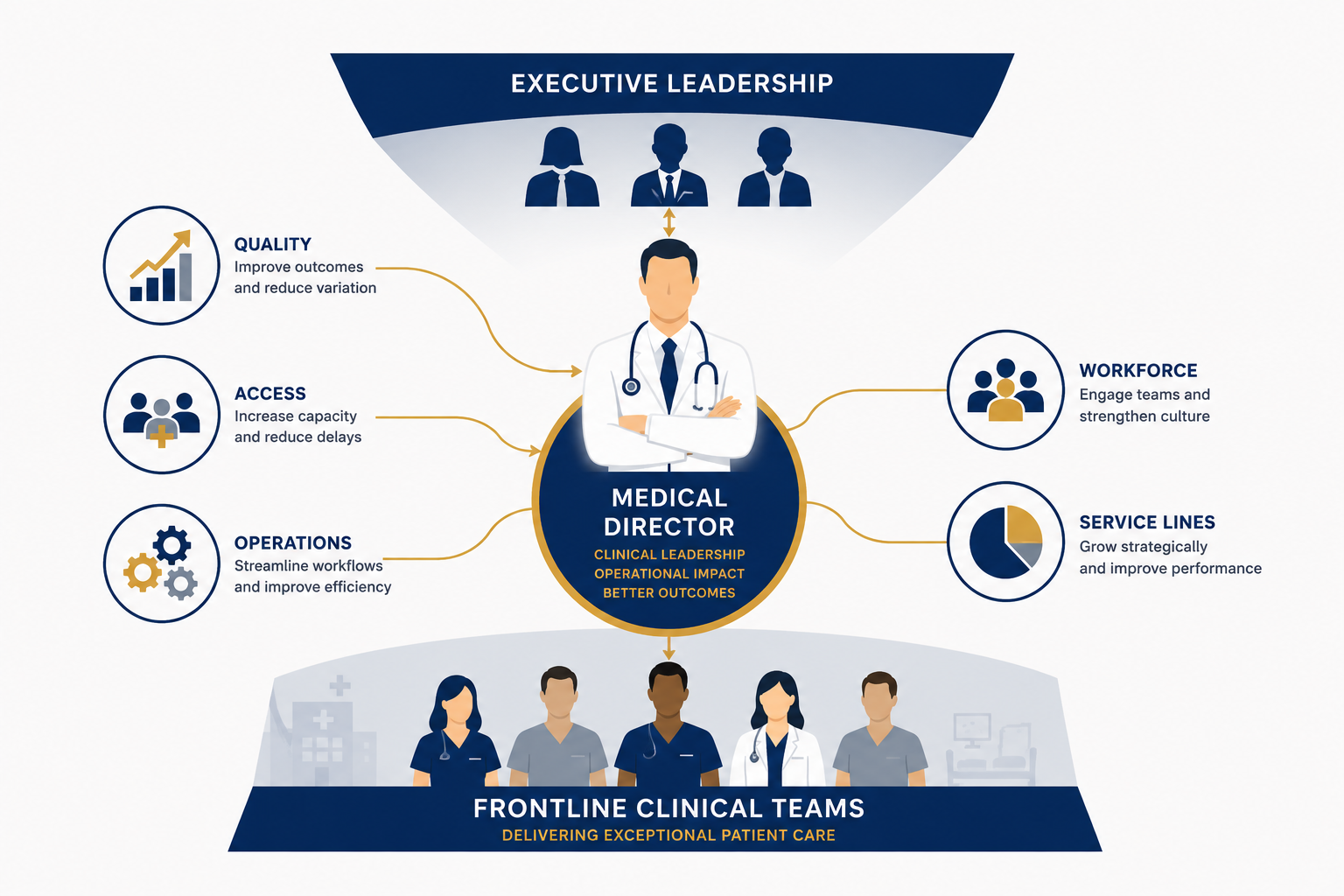
Healthcare organizations often respond to operational challenges by appointing a medical director. The expectation is understandable: stronger physician leadership will improve quality, increase access, strengthen physician engagement, and help drive operational performance.
But many organizations discover that little changes.
Meetings continue. Recommendations are made. Clinical concerns are identified. Yet patient access, throughput, quality metrics, physician engagement, and service line performance remain largely unchanged.
The issue is rarely the physician serving as the medical director. More often, it is the way the role has been designed.
The Leadership Challenge
A medical director title can signal leadership, but the title alone does not create operational influence. The role must be intentionally designed with clear authority, defined responsibilities, and the organizational support needed to improve performance.
Many healthcare organizations expect medical directors to influence quality, access, service line growth, physician engagement, and operational execution. Understanding whether the underlying operating model supports those expectations often begins with an operational assessment. Too often, however, the role is defined by title rather than function.
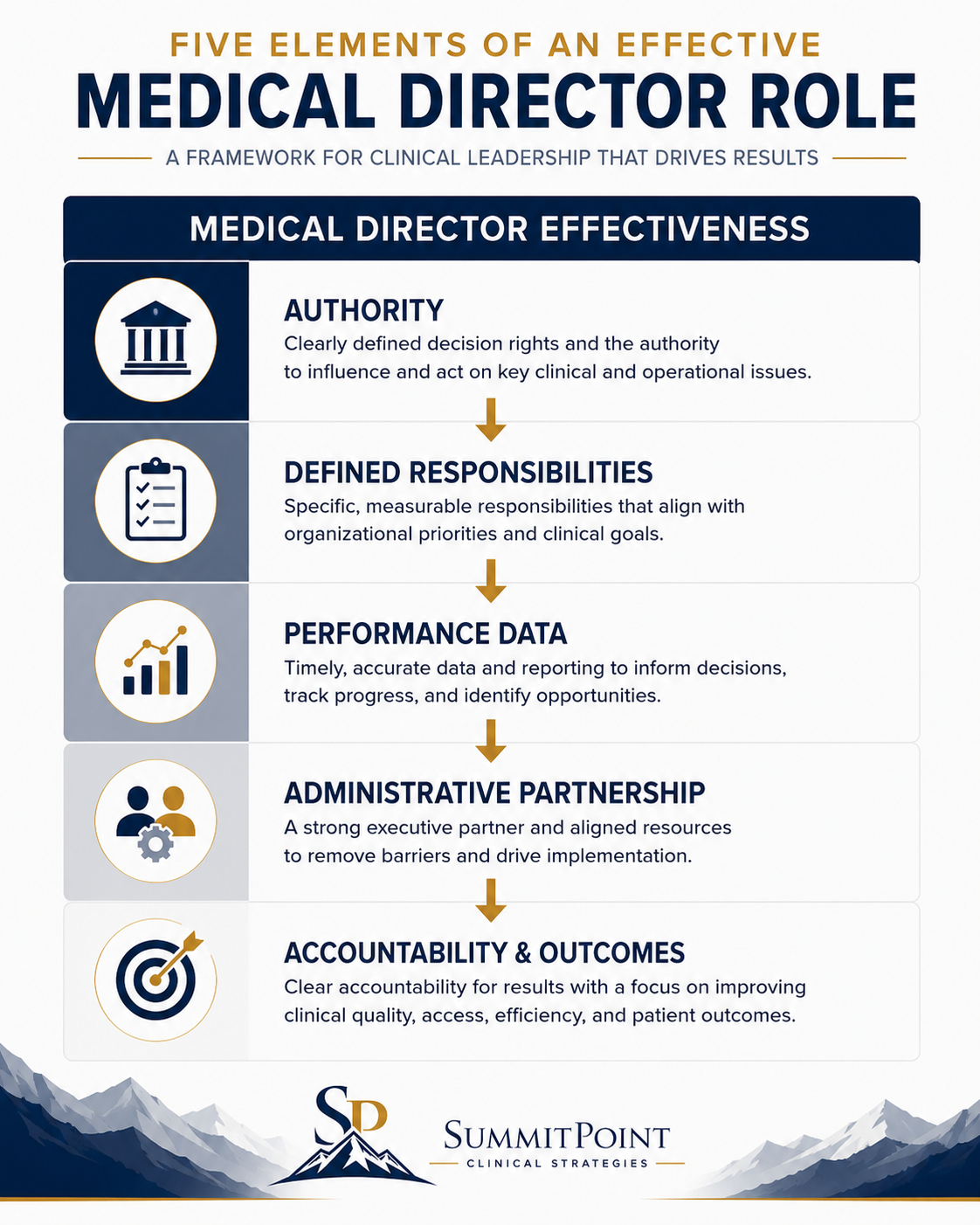
A medical director without clear expectations, decision rights, performance data, administrative partnership, and accountability is placed in an impossible position. They are expected to improve outcomes without the tools required to change the system.
What Leaders Usually See
The organization appoints a capable physician leader. Meetings occur. Advice is shared. Barriers are identified. Yet the same operational problems persist because physician leadership alone cannot overcome inefficient clinical workflows or poorly designed operational processes.
Over time, frustration grows on both sides. Executive leaders question why meaningful change has not occurred. Medical directors question why their recommendations rarely translate into operational action.
A medical director cannot be accountable for organizational outcomes without the authority, support, and operating structure to influence them.
The Root Issue
The problem is often role design rather than individual capability.
An effective medical director model clearly defines what the physician leader owns, what they influence, what performance data they receive, what decisions they can make, and who is responsible for implementing agreed-upon changes.
Without those elements, the role becomes reactive. Success depends on personality, informal relationships, and individual effort instead of a sustainable operating model that consistently drives organizational performance.
Where to Start
Organizations conducting this review often benefit from a broader evaluation of governance, accountability, and physician engagement through an operational assessment.
Ask questions such as:
- Are expectations specific and measurable?
- Are performance metrics clearly defined?
- Is sufficient protected administrative time provided?
- Is there an operational dyad partner?
- Is the medical director involved early enough in key decisions?
- Are there established forums where barriers can be escalated and resolved?
If the answer to several of these questions is no, the organization may have created a leadership title without creating a leadership system.
Questions for Leaders
- What outcomes does the medical director own?
- Which operational decisions can they make independently?
- What performance data do they receive routinely?
- Who is accountable for turning recommendations into operational execution?
A Practical Perspective
At SummitPoint, we view medical directors as one of the most important bridges between clinical reality and executive strategy. When the role is intentionally designed, physician leadership becomes a powerful driver of operational improvement rather than simply an advisory function.
The strongest medical director models connect physician leadership directly to patient flow and operational performance, while supporting long-term service line strategy across the organization.
The Leadership Question
Does your organization have medical directors with clearly designed authority and accountability—or physicians carrying leadership titles without the operating structure needed to succeed?