
Clinic Access Problems Are Often Template Problems, Not Recruitment Problems
Clinic access is often framed as a provider supply problem. While workforce shortages are real, many access challenges begin with something far more operational: a clinic template that no longer reflects actual patient demand.
Before investing significant time and resources into recruitment, healthcare leaders should determine whether existing provider capacity is being allocated effectively.
The Access Challenge
Long wait times are frequently attributed to a lack of providers. In many cases, however, the underlying issue is a mismatch between patient demand and how clinic schedules are structured.
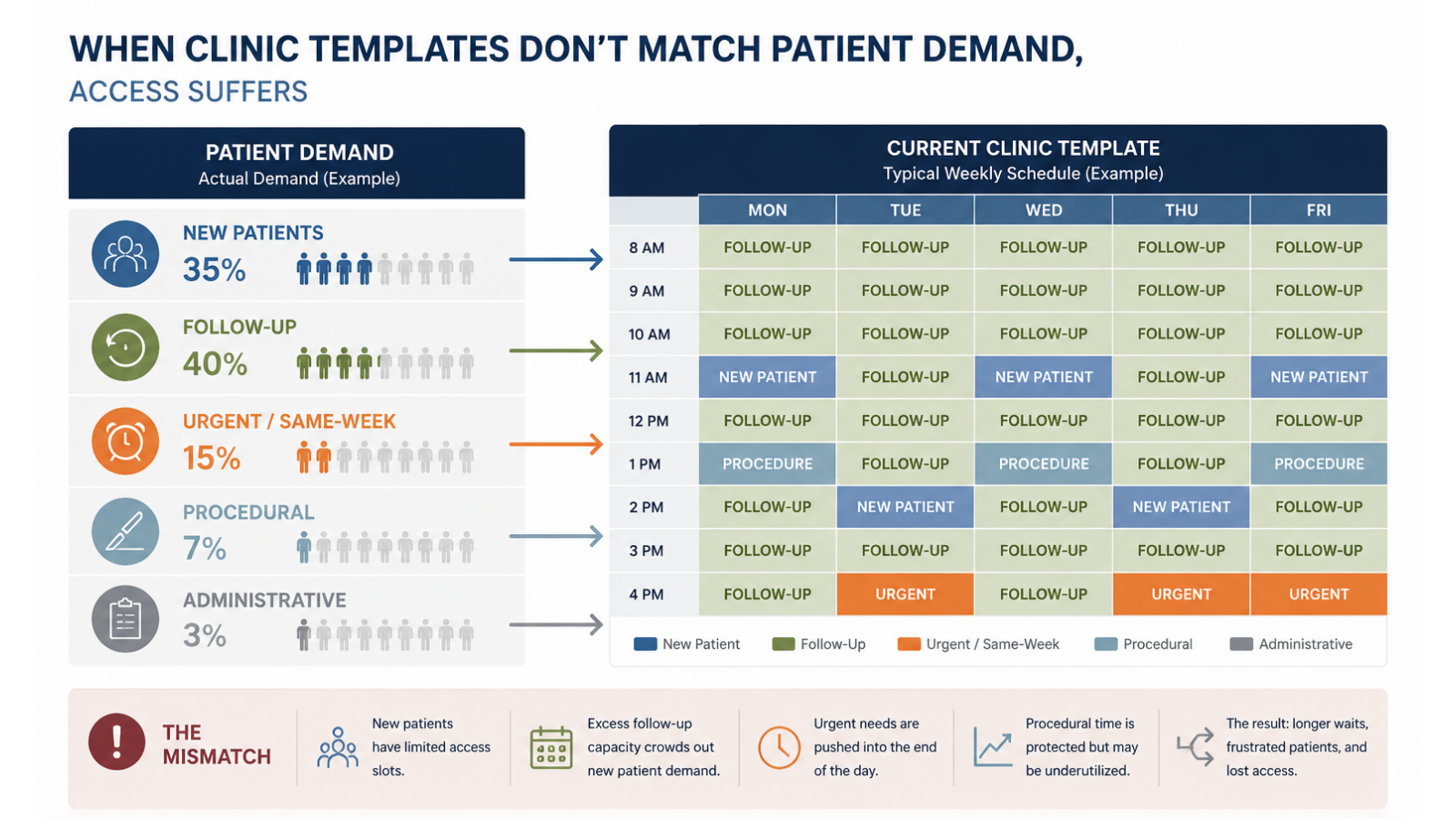
A clinic may have sufficient provider capacity on paper and still struggle operationally. New patients wait weeks for appointments while follow-up visits dominate the schedule. Urgent cases are squeezed into already full days. Follow-up intervals are driven by historical practice patterns rather than clinical necessity. Referral queues continue to grow because there is no standardized process for prioritizing patients based on clinical need.
Access challenges are especially common in specialty practices where referral demand outpaces clinic capacity. Learn more in Specialty Access: Why Adding Providers Alone Does Not Fix the Problem.
What Leaders Typically See
The symptoms are familiar:
- Extended wait times for new patient appointments
- Frustrated referring providers
- High sensitivity to cancellations and no-shows
- Staff requesting constant schedule add-ons
- Providers feeling overbooked despite only moderate productivity
The immediate response is often to recruit additional physicians or advanced practice providers. Recruitment may ultimately be necessary, but it is rarely the first operational solution.

Understanding the Operational Breakdown
Clinic access is influenced by five interconnected variables:
- True patient demand
- Visit type mix
- Template design
- Referral triage
- Follow-up discipline
When these elements fall out of alignment, access deteriorates regardless of how hard providers and staff are working.
Many clinic access problems are not capacity problems—they are template design problems.
For example:
- A specialty clinic may reserve excessive capacity for routine follow-up visits while new referrals accumulate.
- A primary care practice may lack protected appointments for transitional care or same-week acute visits.
- Advanced practice providers may have available capacity but are not scheduled for visit types that would meaningfully relieve physician demand.
These are template design problems—not necessarily staffing problems.
Where to Begin
Start by separating demand into meaningful categories:
- New patients
- Established patients
- Urgent visits
- Procedures
- Administrative encounters
Then compare actual demand with the clinic template.
The objective is not simply to create more appointment slots. The objective is to ensure the right appointment types are available for the patients who need them most.
Organizations that are unsure whether their access challenges stem from staffing, scheduling, referral management, or workflow design can begin with our Healthcare Operations Assessment. The assessment helps healthcare leaders identify operational constraints and prioritize opportunities for improvement before investing in additional resources.
Leaders should also evaluate the clinical rationale behind follow-up intervals. Every unnecessary routine follow-up carries an opportunity cost. It may delay a new patient evaluation, postpone care for a higher-risk patient, or push patients to seek services outside the organization.
Questions Every Leadership Team Should Ask
- How many referrals are waiting, and how are they prioritized?
- What percentage of appointments are routine follow-up visits?
- Which visit types can be safely managed by advanced practice providers?
- What criteria determine urgent versus routine scheduling?
- Does the current template reflect actual demand or historical scheduling habits?
A Practical Perspective
At SummitPoint Clinical Strategies, we view access improvement as an operational design challenge rather than simply a staffing challenge.
Meaningful improvement requires leaders to understand exactly which type of access is constrained, why the constraint exists, and what workflow or template changes will produce sustainable results.
Only after those operational questions have been answered should organizations determine whether additional provider capacity is truly required.
The Leadership Question
Before assuming your access problem is a recruitment problem, ask a different question:
Has your clinic compared actual patient demand with the template it expects providers and staff to work within?
The answer often reveals opportunities to improve access without adding a single provider.