
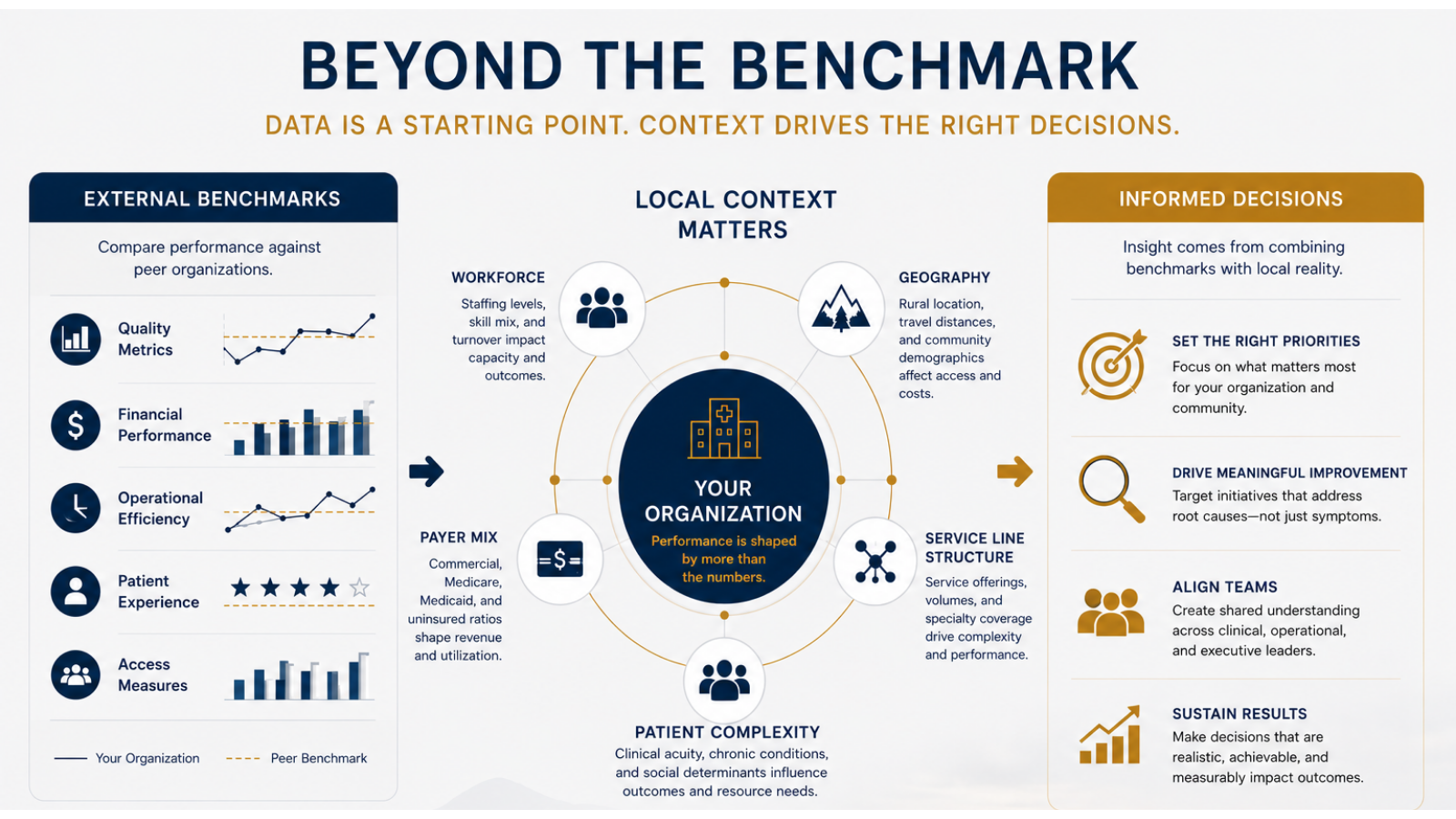
Benchmarks are useful when they create better questions. They become risky when leaders treat them as complete answers without understanding the local operating reality behind the number.
The Strategic Challenge
External benchmarks can be useful. They give leaders a reference point, create accountability, and help identify outliers. But benchmarks can also mislead community hospitals when they are applied without enough local context.
A metric that looks unfavorable on a dashboard may reflect geography, payer mix, transfer patterns, patient complexity, limited specialist coverage, or service line structure. Conversely, a favorable metric may hide an operational weakness that has not yet surfaced.
The problem is not benchmarking. The problem is treating benchmarks as answers instead of starting points.
What Leaders Usually See
Community hospitals are often compared to peer groups that only partially resemble their actual operating environment. The data may not capture call coverage limitations, patients seeking care outside the system, local transportation barriers, post-acute constraints, or the difference between a regional referral center and a stand-alone community facility.
This can lead to two mistakes. Leaders may chase the wrong target, or they may dismiss a valid concern because the benchmark appears acceptable.

Why the Usual Fix Falls Short
Benchmarks become dangerous when they are separated from operating reality. A number without context cannot explain whether performance is driven by process, staffing, patient mix, access constraints, technology, or market dynamics.
That context is especially important in rural and community hospitals, where small changes in staffing, coverage, or volume can materially affect performance.
Benchmarks should start conversations—not end them. Without operational context, even accurate data can lead organizations toward the wrong decisions.
Where to Start
Use benchmarks to identify questions, not conclusions. When a metric is unfavorable, ask what local factors may be contributing. When a metric is favorable, ask whether the result is sustainable and whether it reflects the experience of patients and staff.
Pair external benchmarks with internal trend data, frontline observation, and service-line specific review.
Questions for Leaders
- What exactly is the benchmark measuring?
- What local context is missing?
- Is the peer group actually comparable?
- What internal trend confirms or challenges the external comparison?
A Practical Perspective
SummitPoint’s perspective is that healthcare leaders need both comparative data and operational interpretation. Benchmarking should guide inquiry, not replace judgment.
The strongest organizations know when to standardize and when to adapt based on local reality.
The Leadership Question
When your organization reviews external benchmarks, do leaders understand what the metric is measuring, what it is missing, and what local context may change the interpretation? External benchmarks can identify where questions exist, but they rarely explain why performance varies. If you’re evaluating operational performance across your organization, our operations assessment can help identify areas where deeper analysis may be warranted.