Care Coordination Is Not Complete Until the Loop Is Closed
September 6, 2026•Jessica Rogers, MSN, RN
A patient is referred to a specialist. The order is entered, the referral is transmitted, and the task is marked complete.
But the patient is never scheduled.
From the perspective of the workflow, an action occurred. From the perspective of the patient, the intended care did not.
Care coordination is often measured by whether a process was initiated: a referral was entered, discharge instructions were provided, a follow-up order was placed, or a message was sent.
Each action matters. But none confirms that the patient received—or made an informed decision about—the intended care.
The real measure of coordination is whether the next step was resolved, the outcome reached the right person, and someone responded when the expected process did not occur.
The Gap Between Initiation and Resolution
Healthcare workflows frequently depend on work moving between people, departments, and organizations. Every transition creates an opportunity for information, ownership, or accountability to be lost.
A referral may remain unscheduled because the patient could not be reached. A specialist may be waiting for records or prerequisite testing. A patient may leave the hospital without understanding which clinician to contact. A test result may return after a transition of care with no clearly identified owner.
The individual steps may appear complete in the medical record even though the intended outcome remains unresolved.
That is the difference between documenting activity and closing the loop.
Closing the loop requires more than documenting that something was initiated. It requires visibility into what happened next, who owns the next action, and what occurs when the expected outcome does not happen.
Organizations often find that these gaps are not isolated communication problems. They are workflow reliability problems involving unclear ownership, inconsistent processes, missing escalation pathways, or limited visibility across organizational boundaries.
Where Coordination Commonly Breaks Down
Closed-loop care coordination depends on several connected workflows functioning as one system.
Referrals
Entering a referral is only the beginning.
Scheduling, authorization, required records, prerequisite testing, patient outreach, and unsuccessful contact attempts can all affect whether the patient actually receives care.
If the patient is not seen, the referring team needs a reliable way to know and a defined process for determining what happens next.
This is particularly important when referral delays affect access, specialty care, or the ability to keep patients within the appropriate care setting.
Referral management should therefore be designed around more than referral volume. Leaders should understand where referrals are waiting, why they are waiting, who owns the next step, and when unresolved referrals are escalated.
Transitions of Care
Discharge summaries and after-visit instructions are important, but information alone does not create a reliable transition.
Patients need to understand their medications, warning signs, follow-up plan, and whom to contact with questions. The receiving clinician needs timely access to the information required to continue care.
The transition is not complete simply because the discharge documentation was finalized.
A reliable process confirms that the information reached the appropriate person, that the patient understands the plan, and that unresolved issues have an identified owner.
SummitPoint approaches clinical reliability as a system issue involving care pathways, handoffs, follow-up processes, escalation, and accountability—not simply documentation.
Patient Education
Education is often treated as something delivered rather than something understood.
Written instructions do not confirm that a patient can follow the plan.
Language needs, health literacy, transportation, medication affordability, caregiver involvement, and other barriers may affect what happens next.
Teach-back and documentation of unresolved barriers can help turn education into an actionable plan.
The important question is not simply:
Was the information provided?
It is:
Did the patient understand what to do, have the ability to do it, and know what to do if the plan could not be followed?
Follow-Up and Results
Orders, tests, and recommendations create future work—and that work needs an owner.
Reliable systems define who monitors completion, reviews the result, communicates with the patient, and escalates when the expected action does not occur.
Without that clarity, follow-up depends too heavily on memory, inbox vigilance, and individual workarounds.
A result that is available in the electronic medical record is not necessarily a result that has been acted upon.
Closed-Loop Coordination Requires Ownership
Many coordination failures are not caused by a lack of effort.
They occur because responsibility becomes unclear once work crosses a boundary.
The referring clinician may assume the specialty office will contact the patient. The specialty office may be waiting for missing records. The patient may believe the appointment has already been scheduled.
Meanwhile, no one is clearly accountable for recognizing that the process has stalled.
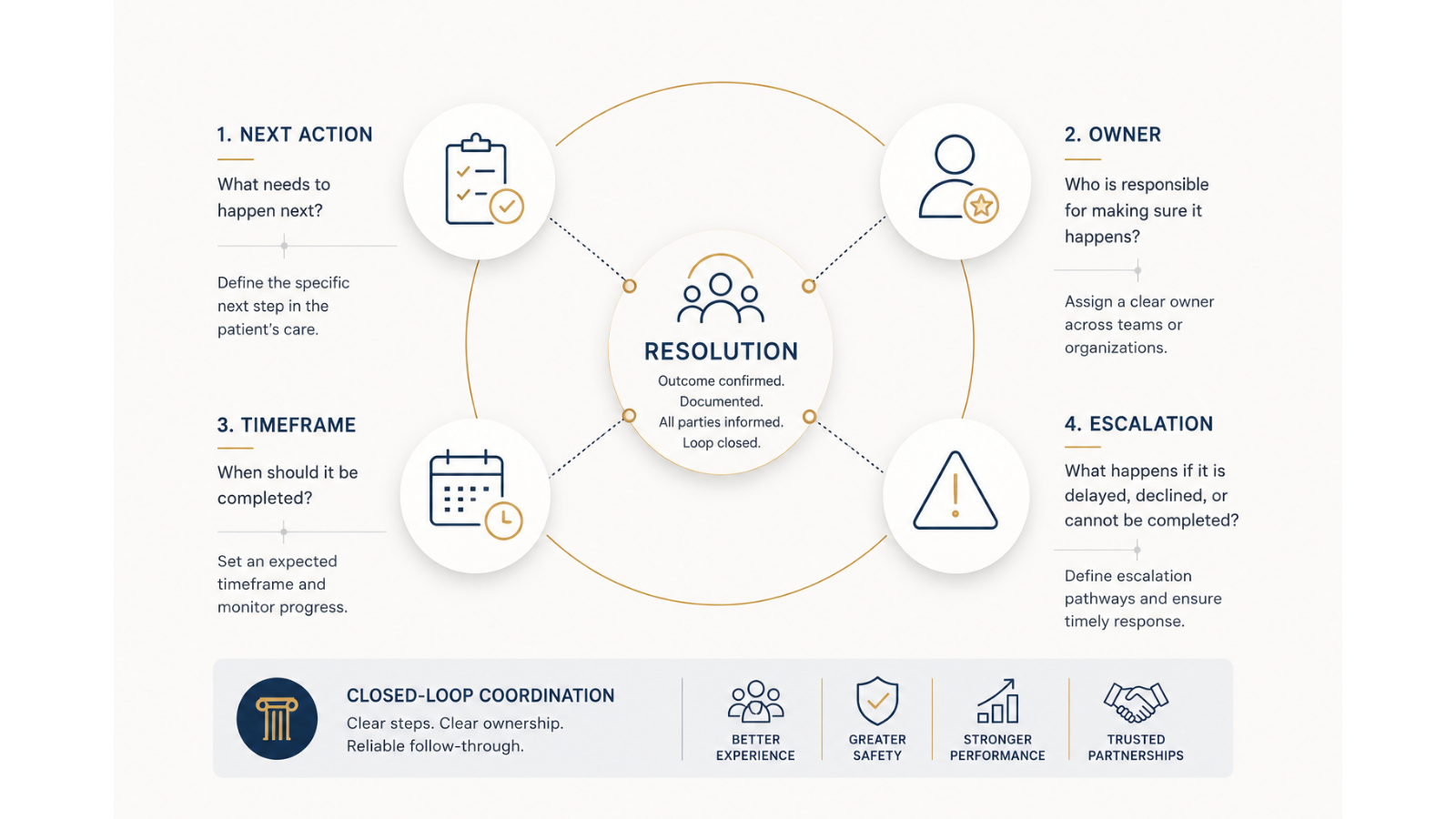
A closed-loop workflow should answer four questions:
What needs to happen next?
Who is responsible for making sure it happens?
When should it be completed?
What happens if it is delayed, declined, or cannot be completed?
These questions are simple, but they expose many of the weaknesses that exist between departments, teams, and organizations.
Closing the loop does not mean every patient must complete every recommendation.
The final outcome may be completed care, rescheduling, an alternative plan, or an informed decision not to proceed.
What matters is that the outcome is known, documented, and addressed appropriately.
Technology Helps, but Workflow Comes First
Electronic referrals, automated reminders, shared work queues, and transition alerts can improve visibility.
But technology cannot compensate for an undefined process.
An alert without an owner becomes another notification.
A work queue without escalation rules becomes a holding area.
A dashboard without a response process may show where coordination failed, but it does not prevent the next failure.
Technology is most effective when it supports:
Clear roles
Expected timeframes
Standardized statuses
Defined escalation pathways
Visibility into outstanding work
Reliable documentation of resolution
Measure Reliability, Not Just Activity
Organizations often measure how much coordination work was initiated:
Referrals placed
Discharge instructions documented
Follow-up orders entered
Patient messages sent
Those measures describe activity.
They do not confirm resolution.
Reliability measures go further:
Referrals completed or otherwise resolved within the expected timeframe
Post-discharge appointments scheduled and attended
Abnormal results communicated and acted upon
Patients reached after unsuccessful initial contact
Unresolved barriers escalated to the appropriate person
Leaders should also examine whether referring teams can see the status of a referral, whether prerequisites are standardized, who owns results that return after a transition, and what happens when a patient cannot complete the recommended plan.
These questions shift the focus from:
Did someone do the task?
to:
Did the intended outcome occur?
That distinction matters because operational performance is ultimately reflected in what happens to the patient—not simply what appears as completed in the record.
SummitPoint’s approach to operational performance emphasizes identifying where care slows down, where ownership or handoffs fail, and where workflow changes can improve reliability.
From Handoff to Reliability
Care coordination should not depend on patients navigating disconnected processes or clinicians remembering to check whether someone else completed the next step.
A reliable system makes the next action visible, assigns responsibility, confirms the outcome, and responds when the expected step does not occur.
Leaders can begin by selecting one high-risk workflow—such as specialty referrals, post-discharge follow-up, or abnormal test results—and tracing it from initiation through final resolution.
Look specifically for the points where:
Ownership becomes unclear
Status is no longer visible
Work moves between departments
Patients become responsible for coordinating the next step
Prerequisites are missing
Escalation does not occur
Staff create workarounds to keep the process moving
Those points are often where workflow redesign should begin.
Organizations do not necessarily need another communication tool. They may need a clearer process, a defined owner, a measurable timeframe, and a reliable escalation pathway.
A structured operational assessment can help leaders identify where workflow reliability, ownership, and follow-through are limiting performance before investing in additional technology or resources.
Because a referral entered is not necessarily care received.
Instructions provided are not necessarily instructions understood.
And a handoff sent is not necessarily a handoff completed.
Care coordination is complete only when the loop is closed.