

A full specialty clinic can look like success.
The schedule is booked for weeks. New-patient referrals continue to arrive. Inpatient consult volume is high. Procedures are being scheduled. Physicians and advanced practice providers appear continuously busy.
From a distance, the conclusion seems straightforward: demand is strong, therefore the service line is healthy.
But demand does not equal sustainability.
Demand answers whether patients need the service. Sustainability answers whether the organization can reliably provide it.
A service line can have more patients than it can accommodate and still operate on a fragile foundation. The problem may not be whether patients need the service. It may be whether the organization has built a clinical and operational model capable of meeting that demand reliably over time.
A cardiology program may have strong clinic demand but depend on one physician carrying an excessive share of inpatient call. A GI service may have months of procedure demand but insufficient anesthesia or endoscopy capacity. A neurology clinic may have a growing wait list while patients leave the system because they cannot obtain timely appointments. A urology program may appear stable only because temporary coverage continues to fill a permanent gap.
Each service is busy.
None is necessarily sustainable.
Demand answers whether patients need the service. Sustainability answers whether the organization can reliably provide it.
Busy Can Signal Demand—or Strain
Healthcare leaders understandably look at volume when evaluating service lines. Referral counts, clinic visits, procedures, inpatient consults, market share, and wait times all provide valuable information about patient need and utilization.
But those measures do not tell leaders whether the operating model supporting that volume is durable.
Consider a specialty clinic with a three-month new-patient wait.
One interpretation is that the market supports expansion. That may be true.
But the wait could also reflect one physician covering a market that requires two, poorly designed templates, inadequate APP integration, excessive inpatient obligations, limited procedure access, or referrals accumulating because the service cannot move patients through the system efficiently.
A long wait list identifies a capacity mismatch. The sustainability question is more difficult:
Why is capacity constrained, and can the organization realistically correct it with a workforce, coverage, infrastructure, and financial model it can maintain?
That distinction matters.
Insufficient capacity does not automatically mean a service line is unsustainable. It means leaders need to understand what is constraining capacity and whether the solution is operationally and financially feasible.
The same issue appears in procedural services.
An orthopedic program may have significant surgical demand, but growth may be constrained by OR block availability, anesthesia coverage, sterile processing, rehabilitation access, or inpatient beds.
A pulmonology program may generate increasing procedural demand but struggle because bronchoscopy access competes with other services or trained support staff are limited.
In each case, physician demand may be obvious while the actual constraint sits somewhere else.
The critical question is not simply how much demand exists. It is what prevents the organization from converting that demand into reliable, sustainable capacity.
Start With the Market: Demand and Access
Demand remains the starting point.
Leaders should understand referral volume, disease burden, utilization patterns, market share, outmigration, inpatient demand, and the realistic volume available within the service area.
But theoretical market opportunity and accessible demand are not the same thing.
A market may have enough patients to support a service in aggregate while geography, payer mix, referral relationships, competing systems, or patient preferences make only a portion of that volume realistically attainable.
Access matters just as much.
A service line that technically exists but cannot provide timely, reliable access may not be accomplishing its strategic purpose.
Can new referrals enter the system efficiently?
Are urgent patients identified and prioritized appropriately?
Can established patients obtain follow-up when they need it?
Are diagnostic studies completed within a reasonable timeframe?
Are procedures delayed because downstream capacity is full?
These questions expose an important dynamic: referral leakage often begins with access friction.
Patients do not always leave because another organization offers fundamentally better care. They may leave because obtaining the service locally takes too long or requires too many disconnected steps.
A full clinic can therefore coexist with substantial outmigration.
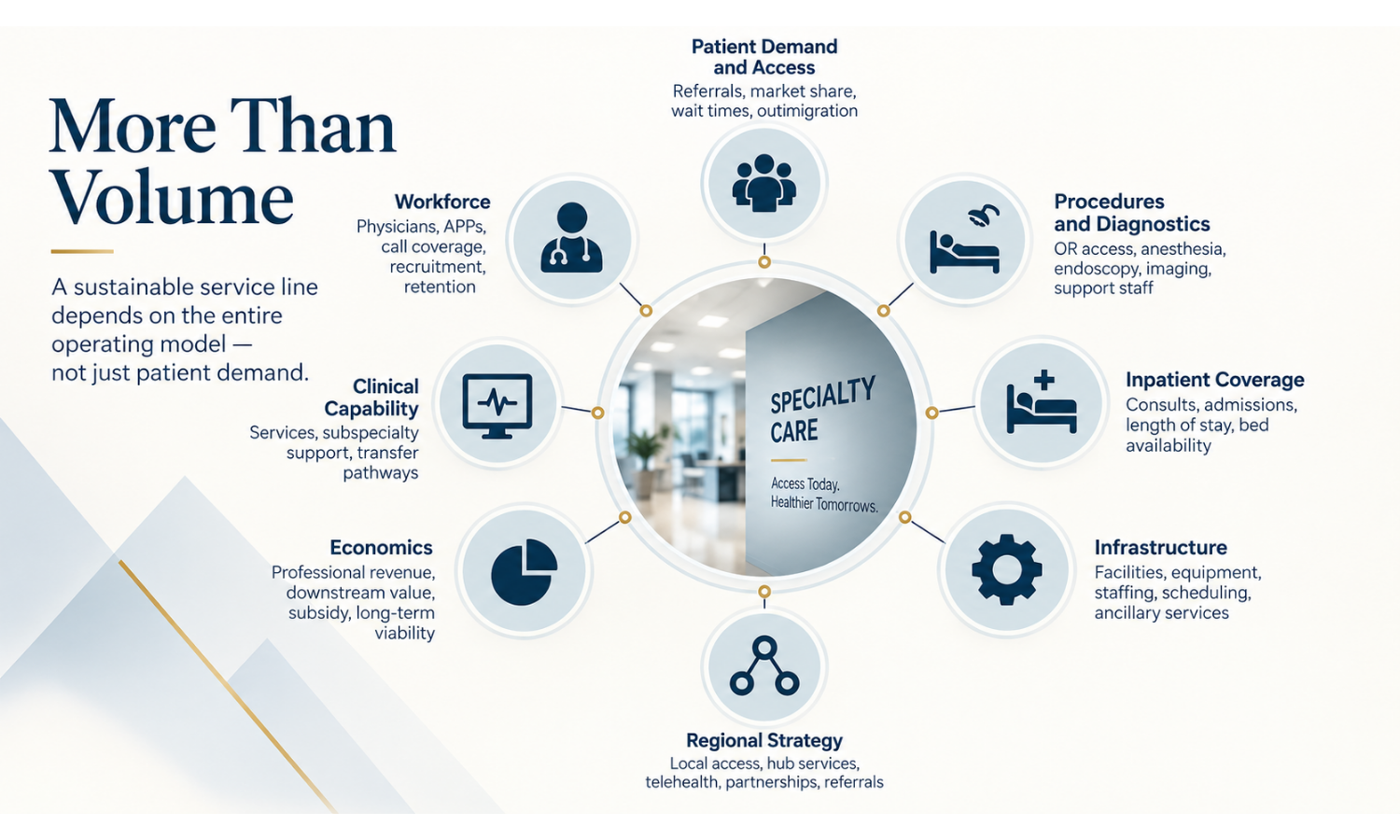
Examine the Delivery Model: Workforce, Capability, and Infrastructure
Once demand is understood, the next question is whether the organization can deliver the service reliably.
This is often where apparent strength becomes fragility.
A service line may function well because one physician is absorbing disproportionate call, seeing additional patients, covering multiple locations, or compensating for vacancies.
That arrangement can produce impressive volume while simultaneously increasing organizational risk.
The appropriate question is not simply:
“How productive is the physician?”
It is:
“Could this model reasonably continue for the next several years?”
Call frequency, weekend coverage, inpatient responsibilities, clinic expectations, procedural workload, administrative duties, geographic travel, recruitment feasibility, and retention risk all matter.
The same principle applies to APP utilization.
Adding an APP without redesigning visit types, escalation pathways, physician responsibilities, and follow-up ownership may increase cost without creating meaningful capacity.
Capability Is More Than Recruitment
Clinical capability is equally important.
Recruiting a specialist does not automatically create a sustainable service line.
A cardiologist may require advanced imaging, cath-lab access, nursing support, transfer pathways, and subspecialty backup.
A gastroenterologist may require anesthesia, endoscopy staff, pathology, surgical backup, and adequate procedural capacity.
A urologist managing acute inpatient disease may need interventional radiology or reliable transfer capability for cases beyond local resources.
Organizations therefore need to define what the service can reliably provide, not simply what an individual physician is technically capable of performing.
Infrastructure May Be the Real Constraint
Operational infrastructure frequently becomes the real growth constraint.
The limiting resource may be an ultrasound technician, procedure room, anesthesia team, scheduler, CT protocol, OR block, inpatient bed, or prior-authorization process.
Consider a GI program.
The market may support another physician, but recruitment alone does not solve the problem if endoscopy time is limited, anesthesia coverage is inconsistent, inpatient call remains concentrated, and advanced procedures still require transfer.
The market may support growth while the operating model does not yet support expansion.
That is why leaders should ask:
What resource actually limits the next unit of growth?
Until that constraint is understood, adding physicians may simply move the bottleneck somewhere else.
Sustainability Requires Economics and Resilience
Financial viability matters, but it should not be evaluated solely through professional revenue or contribution margin.
Some specialties generate substantial downstream value through imaging, procedures, admissions, surgery, infusion, rehabilitation, or other services.
Others provide essential access even when the professional practice requires organizational subsidy.
Neither situation is inherently problematic.
The problem is when the economics are poorly understood or depend on conditions that cannot reasonably continue.
When a service appears financially viable only because physicians are absorbing excessive call, additional workload, or responsibilities the model does not formally support, part of the service is effectively being subsidized through clinician burden.
Temporary coverage can create a similar dynamic.
Locums can preserve access during recruitment, maintain inpatient coverage, and protect referral relationships. In some markets, recurring temporary coverage may even be an intentional component of the long-term model.
But if temporary coverage becomes a recurring feature of the service, leaders should determine whether it is an intentional strategy or simply the mechanism keeping an unresolved coverage gap open.
Resilience Is the Other Half of Durability
A sustainable service line must also be able to absorb reasonable disruption.
What happens if the highest-volume physician resigns?
What happens if one APP leaves?
What happens if anesthesia availability decreases?
What happens if a locums group becomes unavailable?
What happens if a regional partner changes strategy?
Healthcare cannot eliminate dependency entirely. Many community and regional programs will necessarily rely on a small number of specialists.
The goal is not to eliminate every dependency.
The goal is to understand those dependencies and design around them rather than discovering them during a disruption.
A service that performs well only while every critical person and resource remains in place may be productive.
It is not necessarily resilient.
Regional Strategy: Not Every Capability Needs to Be Duplicated
Sustainability does not always require building every component of a specialty service at every hospital.
In some markets, the stronger strategy is regional.
Clinic access may be local while complex procedures occur at a regional hub. Physicians may rotate across sites. Diagnostic capability may be distributed differently than procedural capability. Telehealth, outreach clinics, coordinated transfers, and formal partnerships may preserve access without requiring every site to maintain a full standalone program.
The strategic question is not simply:
“Can we offer this locally?”
It is:
“What should be local, what should be shared, what should be referred, and what should be built through partnership?”
That distinction is particularly important for rural hospitals, community hospitals, and larger health systems managing multiple sites.
Regional strategy does not necessarily represent a compromise.
It can be a deliberate operating model designed around volume, workforce availability, clinical complexity, and infrastructure.
Seven Questions That Expose Service-Line Fragility
When leaders evaluate a busy service line, volume should start the conversation—not end it.
Ask:
- If one physician left, what would happen to the service?
- How much current access depends on temporary coverage?
- Is the current call burden sustainable?
- Where are patients leaving the system, and why?
- What resource actually constrains growth?
- What volume is required to support the desired coverage model?
- What should be local, shared, referred, or partnered?
These questions shift the discussion from whether the service is busy to whether the organization has built a durable way to meet the demand.
That is the distinction leaders need when deciding whether to recruit, expand, redesign, partner, or invest elsewhere.
Build the Operating Model Behind the Volume
Strong service-line strategy considers demand, access, workforce, clinical capability, infrastructure, economics, resilience, and regional design together.
That analysis may support expansion.
It may show that coverage should be redesigned before another physician is recruited.
It may identify an OR, diagnostic, anesthesia, or staffing bottleneck that should be addressed first.
It may support a regional partnership instead of full local duplication.
Or it may reveal that a highly visible service is relying on a level of clinician burden or temporary support the organization cannot sustain.
The goal is not simply to make a busy service line busier.
The goal is to build an operating model capable of meeting demand reliably, financially, and over time.
SummitPoint Clinical Strategies helps healthcare leaders evaluate these issues through a clinician-led, operations-focused lens—connecting patient demand with the workforce, infrastructure, clinical capability, regional relationships, and economics required to build a service model that can actually be implemented and sustained.
Busy tells you that patients need the service. Sustainability tells you whether the organization has a durable way to meet that need.
If demand disappeared tomorrow, you would know the service line had a market problem.
If one physician disappeared tomorrow, would you discover that it had an operating-model problem?